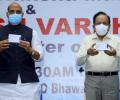
Commercial launch and supply to major government and private hospitals is expected in mid-June.

The flow of deposits from non-resident Indians (NRIs) hit a four-year low in the financial year 2020-21 mainly due to contraction in foreign currency deposits, latest data released by the Reserve Bank of India (RBI) shows. Total NRI deposits during FY21 were $7.3 billion as compared to $8.6 billion in FY20 - the lowest since 2016-17, when such deposits had contracted by $12.3 billion. Indian banks have three kinds of deposit accounts where NRIs or PIOs (persons of Indian origin) can park their funds: non-resident external-rupee account (NRE); non-resident ordinary rupee account (NRO); and foreign currency non-resident bank account (FCNR [B]).

Pune's Mylab Discovery Solutions' CoviSelf, which gives results in 15 minutes, gets ICMR nod

Record liquidity infusion by the central bank in the banking system during the financial year 2020-21 amid sluggish economic activity resulted in banks investing more in safe government papers than in extending loans, data from Reserve Bank of India (RBI) showed. This trend has not been seen in nearly two decades, barring 2016 - the year of demonetisation.

However, Cipla was very clear it does not want to get into vaccine manufacturing.

This apart, to further increase capacities, Bharat Biotech has partnered with Indian Immunologicals (IIL) to manufacture the drug substance for Covaxin. The technology transfer process is underway and IIL has the 'capabilities and expertise' to manufacture the inactivated viral vaccines at commercial scale.

India expects 2.16 billion doses of Covid-19 vaccines between August and December, including the jabs that are currently in clinical trials, reports Sohini Das

Apollo Hospitals and Fortis Healthcare are open to importing vaccines.

The API of Paracetamol, a fever and pain medication, has grown 25 per cent from Rs 450-480 per kg in December 2020 to Rs 580-600 per kg in April. When compared to the pre-Covid prices of December 2019, the surge is much steeper -- around 140 per cent, reports Sohini Das.

Drugs that are used to treat Covid or used by people as immunity boosters have seen a jump in sales and, in turn, rankings.

The Indian regulatory framework forced Citi to hibernate -- contrary to the claim that it never sleeps!

While there is a shortage of testing kits, manpower and capacities, India does not have other scalable testing options.

'This government did not have any plan for safety stocks of essential medicines.'

When compared to the domestic sales of April 2019, the growth is around 37 per cent. However, compared to the previous month (March), the growth is 18.4 per cent.

Artificial shortages and brazen hawking of the drug on the streets at 15 times the normal price rule the day as the official machinery tries desperately to stamp out the parallel market, reports Sohini Das

Delhi, which has been one of the worst affected states, accounted for less than two per cent of total vaccinations in the 18-44 age-group.

Initial data has shown immunity triggered by the two mRNA vaccines -- Pfizer-BioNTech and Moderna -- lasts for at least six months

While the Indian government has been procuring Covid-19 vaccines at low prices so far, manufacturers have to declare the prices of vaccines they would supply to the open market (industries, private hospitals, etc) and state governments before May 1. Sohini Das reports.

Sputnik V is already approved in India and Sinovac is unlikely to come in as it does not meet the criteria.

Since 2014, the public sector banks' branch network in rural and semi urban has grown by a mere 4,000 while for private sector banks, it doubled from 9,673 to 18,437.
 © 2026 Rediff.com - Investor Information - Advertise with us - Disclaimer - Privacy Policy - Sitemap - Feedback - About us - Terms of use - Grievances